
Voices of Liberation
North Carolina Freedom Park features 20 voices of African American North Carolinians who emerged as trailblazers in the pursuit of equality, civil rights, and societal transformation. This Juneteenth, learn more about several of these freedom seekers before and during emancipation.
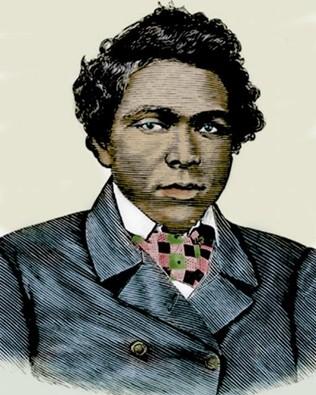
Abraham Galloway
Abraham Galloway was an abolitionist and Civil War spy, and was among the first Black elected officials, becoming a NC State Senator in 1868. Galloway was born enslaved on February 8th, 1837, in Smithville, NC. While enslaved, Galloway became a skilled brick mason and was forced to work along the seaport in Wilmington, NC. In 1857, Galloway escaped slavery by stowing away on a boat and traveling the Underground Railroad to Canada. While in Canada, Galloway became heavily involved with the abolitionist movement. He travelled throughout North America and the Caribbean for recruitment efforts. In 1861, Galloway began working as a spy for the Union Army, taking missions in North Carolina, Louisiana, and Mississippi.
After being captured in an abandoned mission in Mississippi in 1862, Galloway reappeared in New Bern where he shifted his focus from military intelligence to soldier recruitment among the African American and abolitionist communities. Through various public engagements and funding drives, Galloway recruited 30 Black regiments to the Union Army. He also freed his mother from enslavement in Wilmington. With his influence and network, Galloway became a leading political figure and advocate in New Bern and Wilmington. He led Black southern delegates to meet with President Abraham Lincoln to discuss citizenship and voting rights for Black Americans. Galloway was elected as a delegate to the Constitutional Convention of 1868 in Raleigh. Later that year, Galloway was nominated as a presidential elector and became North Carolina’s first Black elector. In 1868, Galloway was elected to the State Senate and was posed to serve a second term, before passing on September 1, 1870, at the young age of 33. Witness the trailblazing voice of Abraham Galloway by visiting North Carolina Freedom Park in Raleigh, NC, where he is featured, and with the North Carolina State Capitol.
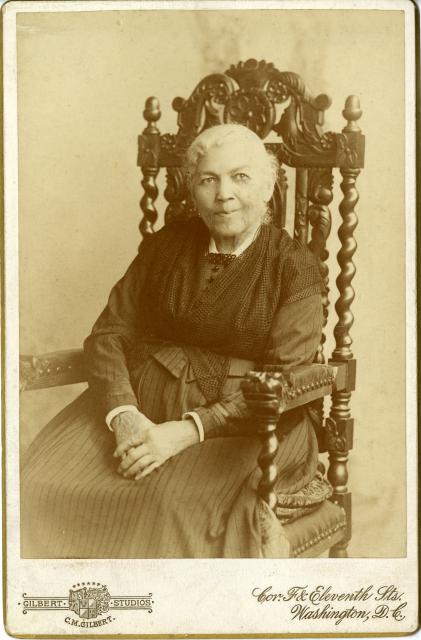
Harriet Jacobs
Born into slavery in Edenton, North Carolina, in 1813, Harriet Jacobs was a renowned abolitionist and the first woman to write an autobiography that delved into the striking realities of slavery for women. At the age of 12, Jacobs became a victim of prolonged sexual abuse at the hands of her enslaver, only finding reprieve from a local attorney who later fathered two children with her. In an attempt to save herself and her children from abuse from her enslaver, in 1835, Jacobs hid in a tiny crawlspace in the home of her grandmother who was a free woman. Her grandmother's home was a block away from her enslaver. The crawlspace was nine feet long and seven feet wide. Jacobs could barely move and often felt mice and rats crawl over her body. There was also hardly any light or ventilation. To watch her children play outside, Jacobs drilled a peephole into the wall. She lived in the crawlspace for seven years, coming out only for brief periods at night for exercise.
In 1842, Jacobs made her escape to freedom to Philadelphia and then New York City where she was reunited with her daughter. Jacobs lived in constant fear and anxiety that she could be recaptured until she legally obtained her freedom in 1852. She later became involved with the abolitionist movement and began writing her autobiography, Incidents in the Life of a Slave Girl. The book was published in 1861 under the pseudonym ‘Linda Brent’. It is one of the first books to speak on the sexual violence, the challenges of motherhood, and the many harsh realities enslaved women had to endure. Witness the trailblazing voice of Harriet Jacobs by visiting North Carolina Freedom Park in Raleigh, NC, where she is featured, and in Edenton with Historic Edenton.
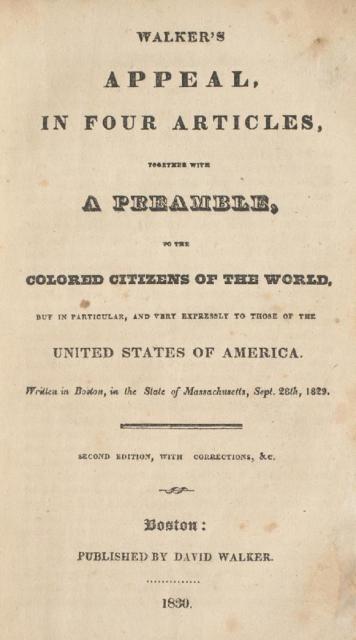
David Walker
Born in Wilmington, North Carolina, to an enslaved father and a free Black mother, David Walker was born a free man. He still, however, witnessed firsthand the injustices of slavery. Walker decided to settle in Boston, but even there, in a free city within the North, he witnessed Black residents face discrimination. The injustices Walker experienced in life led him to become a business leader and an activist. Realizing the power of writing words to impact and enact change, Walker became a writer for the first African American newspaper in the nation, “The Freedom's Journal” based in New York City. A year before his passing, in 1829 David Walker published his Appeal to the Colored Citizens of the World, widely known as David Walker’s Appeal. In this Appeal, Walker encouraged resistance among free and enslaved Black communities. He also condemned those who upheld slavery. David Walker passed away in 1830 at the age of 33. Witness the trailblazing voice of David Walker by visiting North Carolina Freedom Park in Raleigh, NC, where he is featured.