
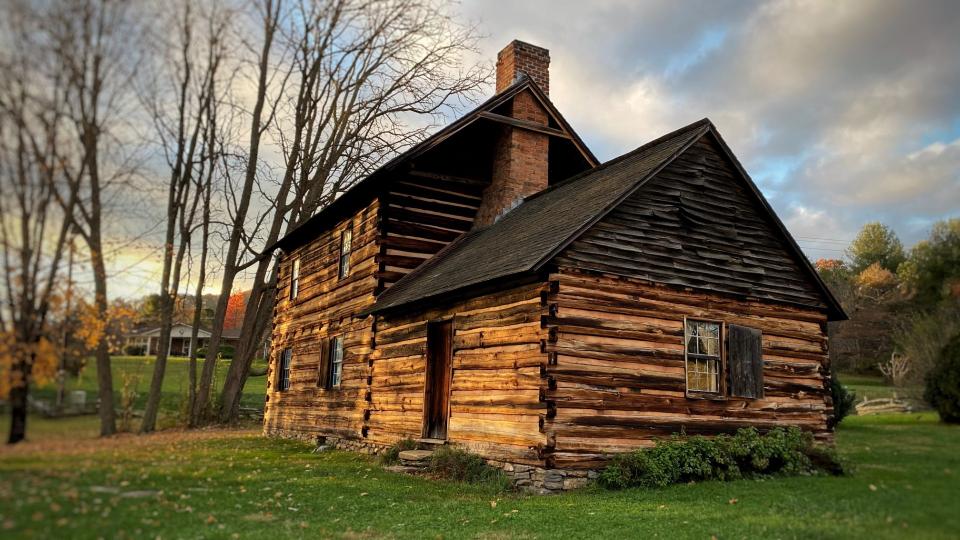
Vance Birthplace
911 Reems Creek Rd. Weaverville, N.C. 28787
Brief History
Vance Birthplace State Historic Site (Weaverville, NC) was the mountain plantation owned by the Vance family and the birthplace of North Carolina’s Civil War governor, Zebulon Baird Vance. Zebulon Vance’s grandfather, Revolutionary War veteran David Vance Sr., originally started their Reems Creek Valley plantation circa 1795. As was common throughout Appalachia, the people enslaved on the Vance plantation were forced to raise livestock such as hogs and necessary food crops such as corn. From 1795 to 1865, the Vances enslaved at least thirty people across North Carolina and Tennessee.
Life for the Vances and the people they enslaved was deeply impacted by the completion of the Buncombe Turnpike in 1828. The Buncombe Turnpike was a 75-mile-long route through the mountains of Western North Carolina from Greenville, TN to Greenville, SC. The Turnpike pushed the economy of Western North Carolina into high gear, encouraging the growth of the burgeoning hospitality industry to accommodate livestock drivers/drovers and tourists to the region. To take advantage of this economic opportunity, David Vance Jr. moved his family, including his son Zebulon and several enslaved people, to start a drover stand in what is now Marshall, NC in the mid-1830s.
Today, visitors to the Vance Birthplace can learn how Zebulon Vance’s influential political career as a governor and US senator was shaped by his upbringing in Western North Carolina. Visitors can also explore the reconstructed Vance house and several other reconstructed and relocated log structures to gain a better understanding of how the Vances and the people they enslaved might have lived from the 1790s to the 1840s.
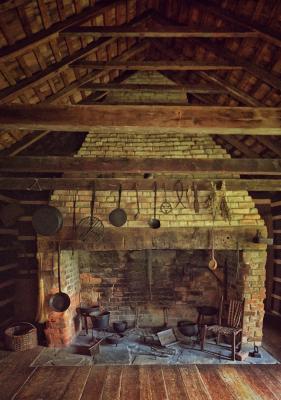
Leah and Sandy Ewin
Born between 1800 and 1806, Leah Erwin was enslaved by the Vances and spent much of her adult life as the cook and housekeeper on their Reems Creek Valley plantation and at their drover stand in present-day Marshall. Leah married Sandy Erwin, whose labor was hired out to the Vances, and the couple had at least four children. The Erwins were living in Asheville and working in Mira Vance’s household when they experienced Emancipation in 1865.
Marriages between enslaved people were not legally recognized, and couples like Leah and Sandy faced the constant threat of separation from each other and from their children. Therefore, the privilege of a legally binding marriage was often one of the first things that freedpeople sought after Emancipation. In 1866, Leah and Sandy registered their marriage at the Buncombe County Courthouse in Asheville, placing their 25-year relationship on the official record.
By 1870, Leah and Sandy had settled in West Asheville and were providing a home for their grandchildren. Sandy listed his profession as farmer in that year’s census, and his property was valued at $60 (roughly $1500 today). This implies that he worked for himself rather than another landowner. Since Leah listed her profession as “keeping house,” she likely stayed home and cared for the house and children. For the first time in her life, she was able to keep her own kitchen and prepare meals for her own family, on her own time. Though many societal forces worked to keep people like Leah and Sandy from advancing in the post-Civil War South, the couple had the freedom to build their own life among family and friends where their time was their own, and their relationship was protected under the law.
Cohabitation Record
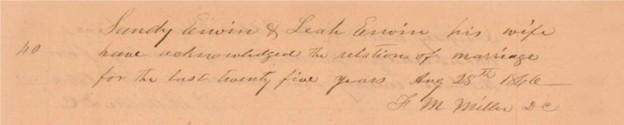
This page of the Cohabitation Records from Buncombe County provided legal proof that Leah and Sandy Erwin were married and that their relationship was protected under the law. The entry reads, “Sandy Erwin and Leah Erwin his wife have acknowledged the relation of marriage for the last twenty-five years.” It is dated August 25, 1866 and is signed by F. M. Miller, a county clerk.
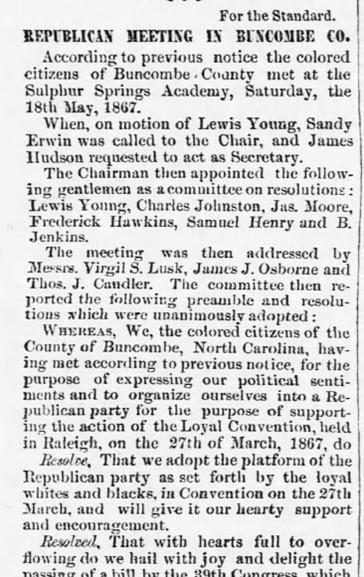
Republican Meeting Article
In May 1867, Sandy Erwin served as the chairman for a meeting of African American citizens calling for the ratification of the 14th amendment to the US Constitution. This amendment extended the rights of citizenship to formerly enslaved people and is often the basis for civil rights legislation and enforcement to this day. While praising the amendment, the Black citizens of Buncombe County at this 1867 meeting declared that by "having the right to vote, we will exercise the right to think."
This article in the Raleigh Standard shares details about the 1867 meeting and lists the resolves written by the men in attendance. In one resolve, the men stated “[t]hat with hearts full to overflowing…we hail with joy and delight the passing of a bill by the 39th congress, which gives us the political rights of citizens.”
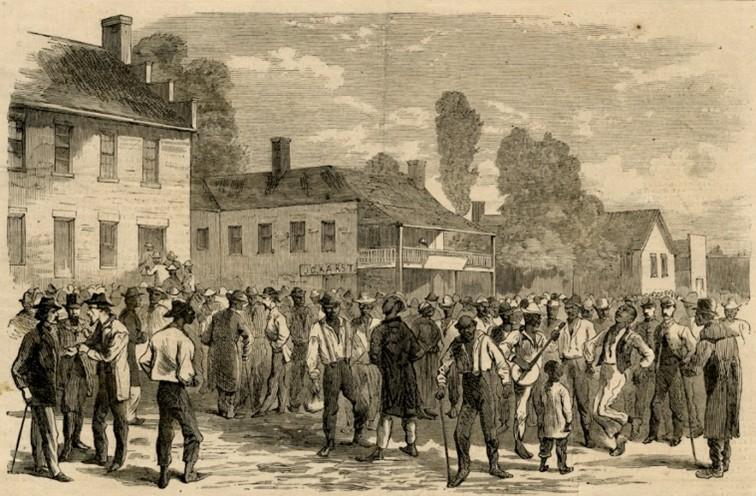
Voter Registration in Asheville
This engraving shows a gathering of Black men in the town square registering to vote for the first time in 1867. It is likely that Sandy Erwin was part of this crowd, waiting in line to gain “this dearest right of an American citizen.”
Hannah and Marion Love
In 1860, Zebulon Vance enslaved 6 people to provide the labor in his Asheville household, including 26-year-old Marion and his wife, Hannah. The couple traveled with the Vances to Raleigh and then to Statesville during Vance’s time as North Carolina’s Confederate governor.
When the war ended in 1865, Hannah remained in the Vance household in Statesville, where she chose to wait for Marion to return from Raleigh. Marion wrote that he wished to reunite with his wife and settle in the capital city. While Harriette Vance hoped they would stay and considered hiring Marion, by 1870, Hannah and Marion had relocated to Raleigh to build a life on their own terms. They raised at least ten children together and bought a house on West Street, where Hannah lived until her death in 1924.
Sanborn Map of the Loves' House
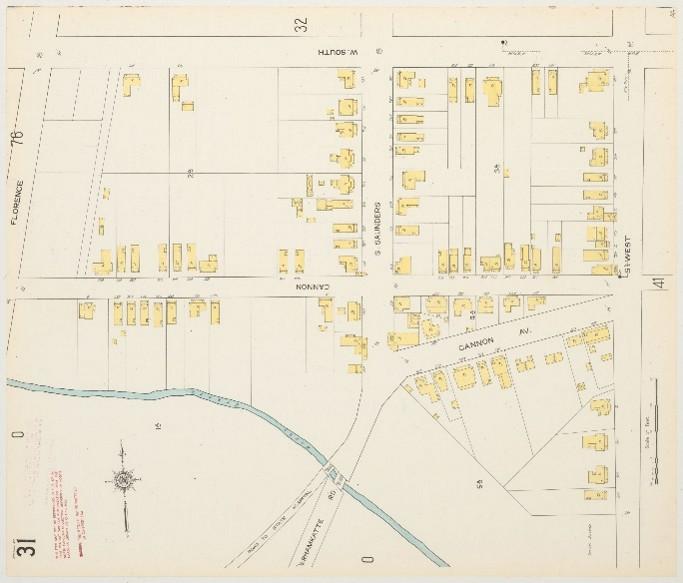
This Sanborn fire insurance map from 1914 shows the location of Hannah and Marion Love’s house in Raleigh. Located at 714 S. West Street, their home was in a residential neighborhood located near the State Hospital, now Dorthea Dix Park.
Hattie Vance Letter—June 9, 1865
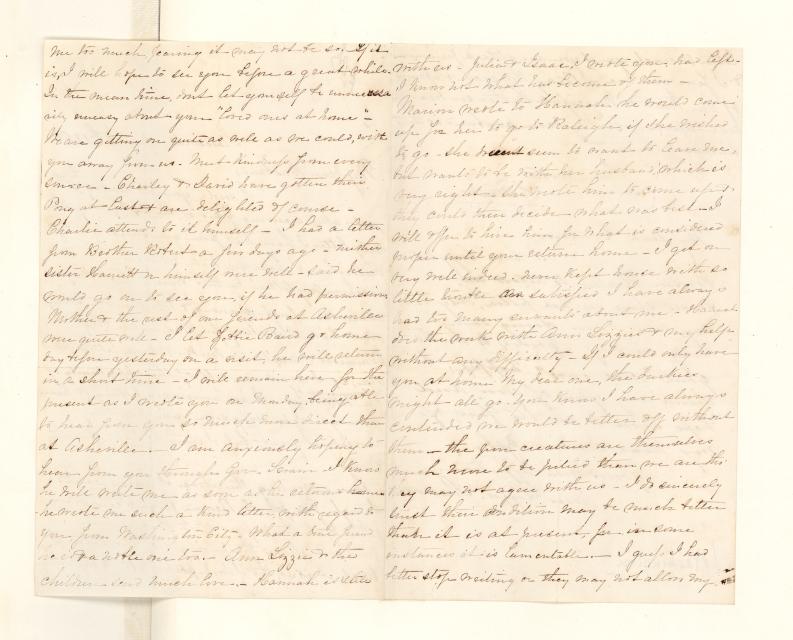
"Letter, Harriette Vance to Zebulon Vance." Courtesy of the State Archives of North Carolina
On June 9, 1865, Harriette Vance wrote to her husband, Zebulon Vance. She provided this information about Marion and Hannah Love: “Marion wrote to Hannah he would come up for her to go to Raleigh, if she wished to go. she doesn't seem to want to leave me but wants to be with her husband which is very right [sic]. She wrote him to come up & they could then decide what was best. I will offer to hire him for what is considered proper until your return home.” The Loves had settled in Raleigh by 1870, choosing not to stay with their former enslavers after Emancipation.