
Know your History!
The Green Book was established by Victor Green as a compiled list of trusted spaces for Black travelers.
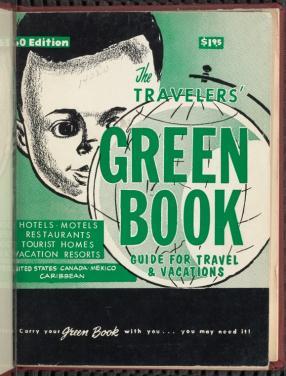
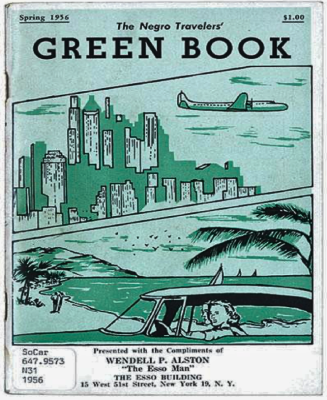
Launched in 1936 it was last published in 1967 (after the passage of the 1964 Civil Rights Act).
From recent novels to the silver screen, the Negro Motorist Green Book has been reintroduced as a pop culture icon.
Then, families used its fabled pages to navigate the twists and turns of segregated roadways. Now, communities can understand this message of safety and extend its impact into advocacy work.
This guide will outline the history, message, and potential of the Green Book as a rubric for organizing ourselves to serve each other and uplift our communities.
Come, let’s take a drive.
“There will be a day sometime in the near future when this guide will not have to be published. That is when we as a race will have equal rights and privileges in the United States.”
Victor Green, creator of “The Negro Motorist Green Book"
Colorful History: A Brief Background on the Green Book
Communities of different ethnic backgrounds relied on each other for safe travels. “Green credited Jewish guides for serving as a template for his book, noting that ‘the Jewish press’ had long printed information about places that are restricted.’” Rather than creed, however, this book was organized along the color line. First published in 1936, the Negro Motorist’s Guide listed amenities that were safe from harassment and discrimination. Barbershops, hotels, and even juke joints (music and dance halls) were featured in between its covers. As the 20th century marched on, it expanded to cover more than the northeast, eventually extending into Canada. The fight for civil rights pushed forward protections for Black families in transit, eventually caused the need for the Green Book to shift, but it remained in circulation for thirty years.
Today, historians, educators, and folks of all ages explore the legacy of the text as they work to understand movement and safety for Black people then and now.
Victor Green’s all-important guide would have sat unused in the dashboard had it not been for community participation. Whether families were seeking service stations after getting a flat tire or looking to dive into a lunch plate, they were the guests of people, not just places. Therefore, as we explore the ways its legacy lives on, it is important to understand collective histories and not just our own
Key Terms
We encourage everyone to understand that the context of the Green Book’s emergence directly relates to the experience of racial profiling, or limiting the accessibility to certain places, resources, or prejudging someone based on their perceived race or ethnicity. Below are some terms related to the Green Book experience that will help you not only make the most of this toolkit but also connect to the rich and complex history of the Carolinas.
Key Terms
Including amusement parks, beaches, bowling alleys and skating rinks, country clubs and golf courses, lakes and ponds, music clubs and nightclubs, regional parks, summer camps, swimming pools, and theaters.
After the American Civil War (1861-1865), most southern states and, later, border states passed laws that denied blacks basic human rights. It is not clear how, but the minstrel character's name "Jim Crow" became a kind of shorthand for the laws, customs and etiquette that segregated and demeaned African Americans primarily from the 1870s to the 1960s.
Refers to the discriminatory practice by law enforcement officials of targeting individuals for suspicion of crime based on the individual's race, ethnicity, religion or national origin.
Foodways are eating habits and culinary practices of people, regions, or historical periods.
The term lodging describes a wide range of accommodation types (hotels, B&Bs, resorts, hostels, motels etc.) that provide shelter or a place to stay overnight. It is used to describe locations away from home, and the quality of the place can vary from a small island hut or a tent to a five-star all-inclusive resort.
During Jim Crow, black travelers frequently carried shoebox meals as a means of staying safe when a Green Book site was not readily available. Although the Green Book provided safe places to eat, restaurants and safe places to stop could be few and far between.
A store or other place where you can have products, equipment, or vehicles checked and repaired and where you can buy parts; The Standard Oil Company of New Jersey, known today as ExxonMobil, was the only major retail distributor of the Green Book through its network of Esso stations, which welcomed Black travelers and also provided business opportunities for Black franchisees.
These have been places not only to get hair care services but locations where black people could be vulnerable and talk about issues of importance in the community. These were spaces where customers played games such as chess, cards, and dominoes, while having conversations about local gossip, politics, and community affairs. Roadways: the part of the road on which vehicles drive. In the Carolinas several roadways were very popular including Route 76, Interstate 77, Interstate 26, Highway 85, and Highway 95.
The part of the road on which vehicles drive. In the Carolinas, several roadways were very popular, including Route 76, Interstate 77, Interstate 26, Highway 85, and Highway 95.
Site-to-Site Connections
What does travel look and feel like today?
- Ask: How do you travel today? Do you usually travel in a group?
- Ask: Where is your favorite place to visit in the Carolinas?
What Makes Us Feel Safe?
- Ask: How do you know if you are welcomed in a community (e.g. places of worship, school, work, your neighborhood, or even within your family, etc.)?
- Ask: What can we do to help keep the Carolinas a safe place to visit now and in the future?
Telling Our Stories
Invite your friends and family to share their stories of experiences with Green Book sites. By sharing and recording our stories we can help create an archive using your voice!
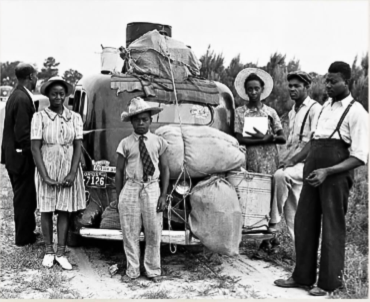
“Black travelers in the South, like this Florida family passing through North Carolina en route to New Jersey for migrant farm work in 1940, knew their passage would be easier — and safer — with help from the Green Book.”
Photograph By Corbis Historical Collection
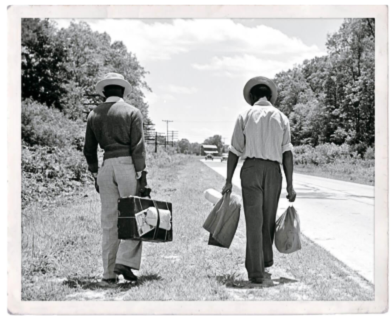
“Migratory agricultural workers of the 1940s — like these men walking the shoulder of NC Highway 27 — would hitchhike north to follow the potato season. A copy of the Green Book, tucked into their luggage, could help them find welcoming places to stay at night.”
Photograph By the Prints and Photographs Division, Library of Congress, LC-USF34-040827-D
Discussion Questions: Visualizing History
What comes alive for you in these photos?
How do you think they felt in those moments?
What catches your eye?
Are you with a group? Use this space to share time, space, and possibly food as you learn more about Green Book history!
Share your photos, videos and stories on social media using the hashtag #CarolinasGREENBOOK along with your zip code, on Twitter, Facebook and Instagram.
Advocacy and Support
Each of these historic sites reflects a unique and rich history. However, some structures need additional support and resources to stabilize their existing buildings and preserve their unique stories. Connect with local organizations that support these efforts.
Connect with local organizations that support these efforts
Reach out to organizations like the North Carolina African American Heritage Commission, which dedicate themselves to preserving and promoting the histories and culture of African Americans in North Carolina. Efforts like the WeGoja Foundation illuminate the stories of the African American experience in South Carolina. Learn site history.
Learn site history
Learn more about extant Green Book sites, like Mack’s Barbershop in Fayetteville, North Carolina. This historic barber shop was much more than a place to get your haircut! It served as a safe meeting place for local organizations and even a small church congregation. Volunteer to raise awareness.
Volunteer to raise awareness
You can help be a conscious steward for historic sites! The Green Book of the Carolinas was launched to help encourage preservation of important sites of Black history. These sites need funding, support, and responsible volunteers to help them remain vibrant places to visit. Contact your local historic preservation agency or museum to find ways to support.
Conclusion
The Negro Motorist’s guide was intended to help its users arrive safely at their destination by offering directions to places of rest, care, and joy along their route. As we further its mission there are many ways that we can support efforts of stewardship and care for marginalized folks in the Carolinas and throughout the world. As you use this guide with your friends, families, and community to understand that we are each other’s safe place–do what you can to protect the history and wellbeing of those around you.
In this way, we can make sure that Victor Green’s mission continues to be realized as we navigate the world around us.
Visit us virtually by visiting our webpages to understand more about the Green Book and its Carolina histories. You can also set out on your own colorful journey using our mapping tool.
Safe travels!
Additional Resources
Tour of Green Book Hotel: Magnolia House
“The Historic Magnolia House was a popular destination and safe haven for African American travelers who had trouble securing accommodations during segregation in America in the mid-twentieth century. It was one of the few hotels between Atlanta, Georgia and Richmond, Virginia that allowed Black travelers to stay overnight due to lodging restrictions under Jim Crow.”
Black Joy x Reckon
“Remembering: The Negro Travelers’ Green Book. The Green Book leaves us with its legacy of exploration and adventure. We feel it in the stories of Black travel woven through #blackhistory, and through the preservation of Hugo-Green’s work by historians, photographers and geographers today.”